
Opinion
Carbon removals: a cost-competitive route to cleaner flying
22 September 2026
Aviation will need more than one solution to tackle its emissions, and high-quality carbon removals can play an important role alongside measures that reduce emissions at source.
Sustainable aviation fuel (SAF) will be an important part of the transition, and the UK’s SAF Mandate already requires an increasing proportion of aviation fuel to come from sustainable sources, reaching 22% by 2040. But SAF cannot address every aviation emission, and even with more efficient aircraft and greater use of lower-carbon fuels, some emissions will remain. That is where high-quality carbon removals can play a complementary role.
The Climate Change Committee’s recent advice on Heathrow’s proposed expansion brings this into focus. If expansion goes ahead, the CCC advises that the aviation sector should fully address its emissions by 2050, either through reducing emissions or purchasing engineered carbon removals.
Bringing carbon removals into the mix
There is an opportunity to consider how engineered greenhouse gas removals (GGRs) could work alongside the SAF Mandate. While SAF reduces the emissions associated with aviation fuel, carbon removals take CO₂ out of the atmosphere and permanently store it, making them particularly relevant to sectors where eliminating every tonne of emissions is difficult.
One technology is bioenergy with carbon capture and storage (BECCS), which captures biogenic CO₂ from bioenergy generation and permanently stores it underground. Where sustainably sourced biomass is used, this can result in a net removal of CO₂ from the atmosphere.
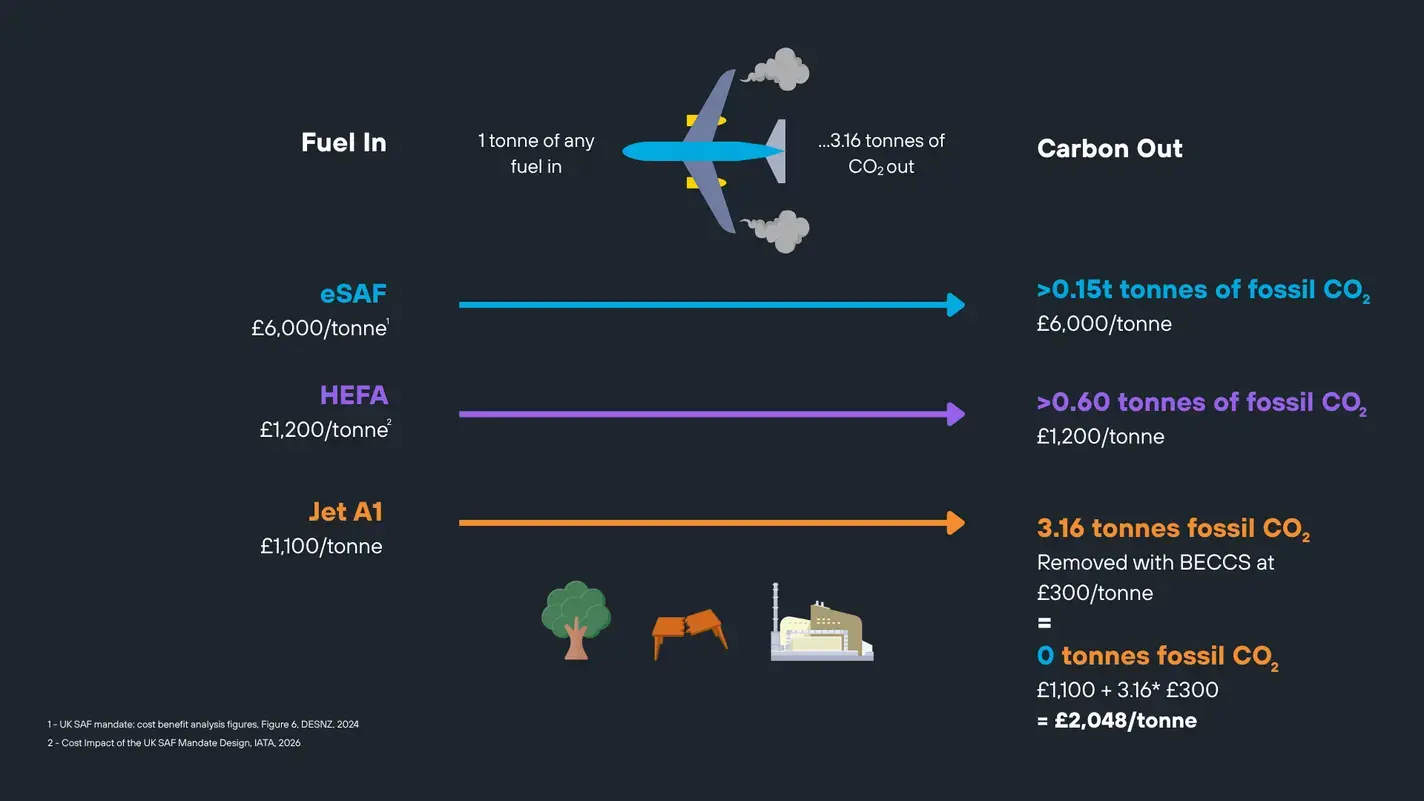
The economics of different decarbonisation options is also important. SAF can currently cost several times more than conventional jet fuel, while engineered carbon removals such as BECCS have the potential to deliver permanent removals at a much lower cost than e-SAF. HEFA, one of the most established SAF pathways, also comes at a significant cost premium.
HEFA is currently the most widely used SAF pathway and is produced from waste oils and fats, including used cooking oil. However, these feedstocks are limited, meaning there is not enough used cooking oil globally to meet aviation’s future fuel needs at scale through HEFA alone.
SAF also does not eliminate aviation’s carbon intensity entirely. Even the lowest-carbon e-SAF pathways can retain around 5–10% of the carbon intensity of conventional jet fuel, while HEFA can have a higher residual carbon intensity.
At Evero, our InBECCS project in Cheshire retrofits carbon capture technology to an existing waste wood energy operation, capturing and permanently storing biogenic CO₂. Projects like this can help build the UK’s carbon removal industry while providing sectors such as aviation with another tool for addressing residual emissions.
More than one solution
The answer to aviation’s emissions challenge is not to choose between SAF and carbon removals. Policy should instead allow emissions reductions and permanent removals to work alongside each other, including by considering how GGRs could be incorporated into the UK’s wider SAF policy framework.
This could help create demand for high-quality carbon removals while giving airlines another way to address emissions that cannot be eliminated at source, alongside the use of lower-carbon fuels.
We shouldn’t have to choose between the family holiday and tackling climate change. The solutions need to work together.


